HR Management Platform
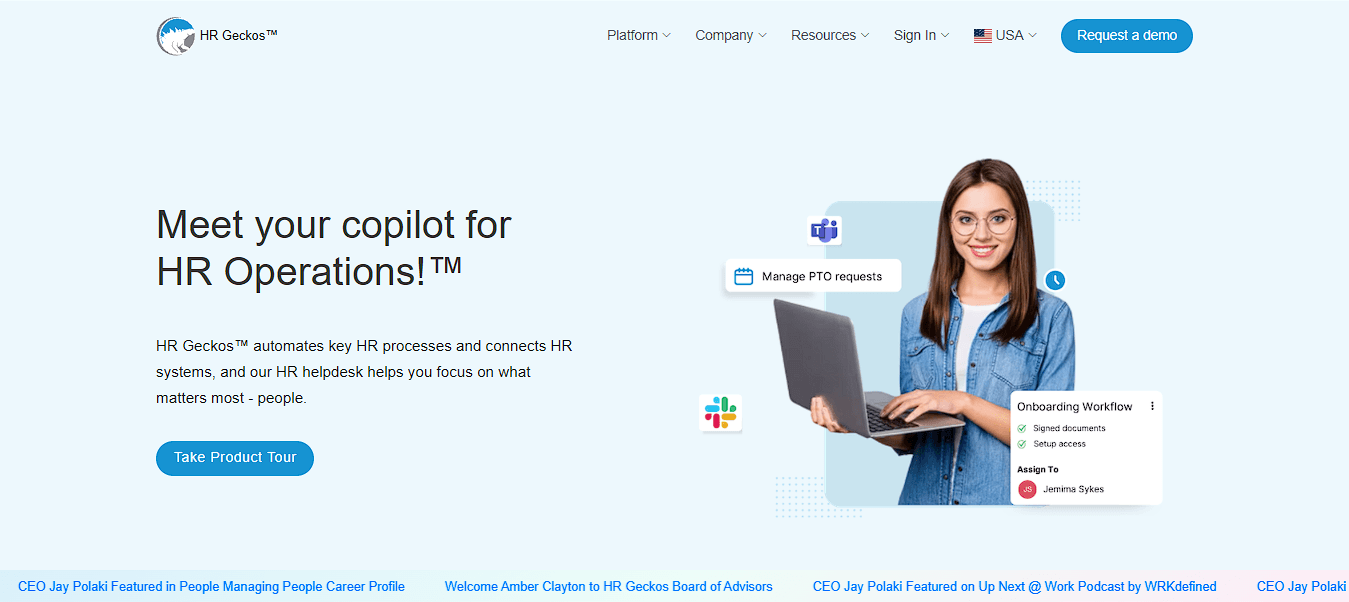
HR Geckos is a US-based HR operations platform that automates HR processes, connects HR systems and runs an HR helpdesk. Working remotely with the US engineering team, I built product interfaces and hardened the authentication and API layer that protects the platform's employee data.
- React
- Node.js
- JWT
- REST APIs
- SQL
Particulars
- Client
- HR Geckos, US-based HR operations platform
- Timeline
- Jul 2025 – Jan 2026
- Role
- Full stack engineer, auth and API security
- Team
- Remote, with a US-based engineering team
- Scope
- HR workflow interfaces, authentication and REST API security
Note: Some implementation details are omitted for confidentiality. This case study covers my role, public product behaviour and general architecture only.
Record summary
35%
Faster time to debug
0
Critical regressions
6
Consecutive sprint releases
01The mandate
HR software holds the most sensitive data a company has: identities, compensation, leave and performance records. The platform needed interfaces that made HR workflows easy for employees and HR teams, and a backend that held up against brute-force logins, injection and abuse without slowing anyone down.
It also had to be debuggable. When something failed in production, a team working across timezones needed to find out why, fast.
02What I owned
On the frontend I built and enhanced React interfaces for HR workflows, from reusable components to responsive layouts. I owned the authentication and authorization path end to end: JWT-based sessions, protected routes and access control between the UI and the API.
On the server I drove the security hardening: IP-based rate limiting, input validation and SQL-injection prevention aligned with the OWASP Top 10, plus the structured error handling and centralised logging that made incidents traceable. I also owned validation of the auth and REST API modules across functional, edge-case, integration and regression scenarios.
03Defence in depth
No single control is trusted to stop an attacker. A request is throttled, authenticated, validated and authorised before it reaches a query, and each layer logs what it rejects. Treating security as a pipeline rather than a checklist made it easier to reason about, and to test.
Fig. 01
04Working flow
The request-level path behind a sign-in and every authenticated call after it. Each check runs before the next layer is touched.
Fig. 02
01 Submits credentials
02 Sends the sign-in request
- 03 IP rate limit, then input validation
04 Looks up the user with an injection-safe query
05 User record
- 06 Verifies credentials, issues a JWT, logs the outcome
07 JWT
08 Calls a protected endpoint with the token
- 09 Verifies the JWT and checks role and access
10 Authorised data, or a logged rejection
05Hard parts
- Adding security controls to a live product without breaking existing user flows.
- Tuning rate limits to stop brute force without punishing legitimate users.
- Replacing ad-hoc failures with structured errors and centralised logs the whole team could read.
- Working asynchronously with a US team, where written context replaced hallway conversations.
- Keeping releases free of critical regressions while security changes touched shared code.
06Outcomes
- Mean time to debug production incidents down roughly 35%.
- Zero critical regressions across 6 consecutive sprint releases.
- Authentication and API security aligned with the OWASP Top 10.
- Auth and REST API modules validated across functional, edge-case, integration and regression scenarios.
07How I approached it
- 01
Assume any layer can fail
Defence in depth means one missed check isn't a breach.
- 02
Logs are a feature
If production can't tell you what went wrong, the system isn't finished.
- 03
Test the unhappy paths
Edge cases and abuse are where auth code breaks.
- 04
Write it down
Remote work across timezones runs on clear written context.
Related work
More projectsKurlClub
SaaS platform, React, Next.js, TypeScript
BFC Pay
FinTech, React, Node.js, Rust
HI5 Overseas
Client application, Next.js, TypeScript, Node.js
Subscriptions
SaaS platform, React, Node.js, Express